





October 12, 2026 · RetailPath
Target Partners Online: A Practical Guide for Suppliers
Learn how Target Partners Online (POL) helps suppliers manage items, purchase orders, sales and inventory data, shipping compliance, invoices, and deductions—plus practical tips for using the portal effectively.
Target Partners Online, commonly called POL, is the central portal for suppliers doing business with Target. It gives vendor teams access to the applications, reports, documentation, and communication channels needed to manage items, orders, shipments, performance, and financial activity.
For many suppliers, POL is where the Target relationship is run day to day. It is where teams find vendor requirements, check purchase orders, review sales and inventory data, and follow up on invoices and deductions.
But POL is also a large environment. Between its applications, reference documents, and reports, new users can struggle to know where to start.
This guide explains what Target Partners Online is, the areas suppliers use most, and how to turn its information into timely, actionable decisions.
What Is Target Partners Online?
Partners Online is Target’s supplier-facing portal. Approved vendors use it to access tools, data, and guidance related to their Target business.
Depending on a supplier’s program, access, and responsibilities, POL may support work across:
- Vendor onboarding and profile management
- Item setup and maintenance
- Purchase order management
- Sales, inventory, and forecast analytics
- Shipping, routing, and transportation
- Supply chain compliance and performance
- Invoicing, payments, and deductions
- Vendor requirements, policies, and announcements
In simple terms, POL connects suppliers to the information and workflows Target uses to buy, move, and pay for their products. Users are typically granted access to specific applications based on their role, so what one person sees may differ from a colleague at the same company.
Why Partners Online Matters for Target Suppliers
POL is more than a document library. Its data and requirements influence decisions across sales, supply chain, operations, and finance.
When used consistently, it can help suppliers:
Stay aligned with Target’s requirements
Target publishes vendor requirements, compliance standards, and program updates through POL. Requirements for labeling, packaging, routing, and shipping can change, and teams that miss updates are more likely to incur avoidable charges.
Monitor product performance
Sales and inventory data, available through Target’s analytics tools such as Greenfield, can show which items, stores, and regions are driving results. Teams can use this to spot growth opportunities, slowing demand, and promotional impact.
Manage purchase orders and shipments
Suppliers need clear visibility into order quantities, ship windows, revisions, and routing instructions to deliver on time and in full.
Protect compliance performance
Target measures supplier execution against its supply chain standards. POL gives teams the information needed to understand misses and correct root causes.
Support faster financial follow-up
Invoice, payment, and deduction information helps finance teams validate charges, locate supporting documentation, and respond within required timeframes.
Key Areas of Target Partners Online
Each supplier uses a different mix of tools, but these are the most important functions to understand.
1. Vendor Setup and Account Management
Every Target relationship starts with accurate vendor information. POL is used to maintain company details, contacts, user access, and other profile information.
Common responsibilities include:
- Maintaining vendor contacts and roles
- Requesting and managing user access to applications
- Keeping remit-to, banking, and tax details current
- Reviewing required agreements and certifications
Practical tip
Assign an internal POL administrator. Access requests, departing employees, and role changes are easy to lose track of, and a single owner keeps access clean and secure.
2. Item Setup and Product Data
Accurate item data is foundational to selling at Target. Suppliers use Target’s item tools to create and maintain product information.
Common responsibilities can include:
- Setting up new items and assortment changes
- Maintaining product attributes and dimensions
- Managing UPC and case pack details
- Supplying digital content and images
- Updating cost and item status
- Coordinating discontinuations and transitions
Errors in item data cause problems downstream. A mismatch in dimensions, case pack, or UPC can affect ordering, receiving, labeling, and online content—and may lead to compliance charges.
Practical tip
Build an internal item-data checklist with sign-off from sales, operations, logistics, and finance before any submission or change.
3. Purchase Orders and Forecasting
Purchase orders are at the center of Target fulfillment. Most suppliers exchange orders with Target through EDI, while POL provides supporting visibility, requirements, and forecast data.
Teams should closely monitor:
- New and revised purchase orders
- Ordered quantities and case packs
- Ship windows and requested delivery dates
- Order cancellations and changes
- Forecasts shared by Target
Practical tip
Set internal milestones ahead of each ship window—production readiness, labeling, ASN readiness, carrier pickup—so issues surface while there is still time to fix them.
4. Sales, Inventory, and Analytics
Target’s analytics tools give suppliers visibility into how products are performing across stores and digital channels.
Suppliers may review:
- Unit and dollar sales
- Store and regional performance
- On-hand inventory and in-stock trends
- Digital and store-fulfilled sales
- Item performance over time
This data supports better planning. If a fast-moving item shows thinning inventory across a region, the supplier can investigate whether the cause is production, open orders, distribution, or demand.
Practical tip
Create a short weekly scorecard with only the metrics that drive action:
- Top sales gains and declines
- Items at risk of being out of stock
- Open purchase orders nearing ship dates
- Compliance exceptions
- New deductions requiring review
5. Shipping, Routing, and ASNs
Target has detailed requirements for how product is routed, labeled, and shipped into its distribution network. Many suppliers ship collect, with freight routed according to Target’s transportation instructions.
A key process is the Advance Ship Notice (ASN). An ASN tells Target what is arriving before it arrives, so the shipment can be received and reconciled accurately.
Accurate shipping execution supports:
- Faster, more accurate receiving
- Fewer shortage and labeling disputes
- Better inventory visibility
- Stronger on-time performance
- Fewer avoidable compliance charges
Practical tip
Treat ASN and label accuracy as a cross-functional responsibility. Warehouse, transportation, and EDI teams should all understand how shipment data affects receiving and chargebacks.
6. Supply Chain Compliance and Performance
Target evaluates suppliers on whether shipments arrive on time, complete, and compliant with its requirements. Misses can result in compliance charges and affect the relationship with the buying team.
Common areas of review include:
- On-time shipping and delivery
- Fill rate and order completeness
- ASN accuracy and timeliness
- Carton labeling and packaging standards
- Routing compliance
Program details vary by fulfillment method and category, so suppliers should always confirm the requirements that apply to their business.
What to investigate when performance declines
- Were orders received too late for normal lead times?
- Did the warehouse ship the wrong quantity?
- Was a pickup missed or routed incorrectly?
- Was the ASN late, incomplete, or inaccurate?
- Did a purchase-order revision go unnoticed?
- Are certain distribution centers or carriers repeating in the exceptions?
The goal is to find the repeatable process issue behind the score and fix it.
7. Invoices, Payments, and Deductions
Financial activity is a major part of managing a Target account. Suppliers can review payment activity, remittance details, and deductions, and dispute charges they believe are invalid.
Target deductions can include shortages, compliance charges, freight-related deductions, allowances, and returns. Each type has its own documentation requirements and dispute timeframes.
Build a deduction-review process
- Identify the deduction type and affected transaction.
- Confirm whether the deduction is valid.
- Gather documentation such as purchase orders, bills of lading, proof of delivery, invoices, and ASN records.
- Submit the dispute within the applicable deadline.
- Track the outcome and record the root cause.
- Use recurring issues to improve upstream processes.
Recovering a deduction is helpful; preventing the next one is more valuable.
Common Partners Online Challenges
POL is valuable, but it is not always simple. Common challenges include:
- Many applications with separate access requirements
- Requirements documents that change over time
- Difficulty finding the right report for a specific question
- Manual downloads and spreadsheet work
- Short windows to dispute deductions
- Unclear internal ownership of Target tasks
These challenges are manageable with clear processes around the portal.
Best Practices for Using Partners Online Effectively
Assign ownership by function
- Sales: product performance and buyer collaboration
- Supply chain: purchase orders, forecasts, and inventory
- Logistics: routing, shipping, labeling, and ASNs
- Finance: invoices, payments, deductions, and disputes
- Item management: product data and content
- Administration: user access and vendor profile
Watch for requirement updates
Make someone responsible for reviewing new announcements and requirement changes in POL and sharing what affects your operations.
Focus on exceptions
Prioritize what needs action: an item trending toward out of stock, an order nearing its ship window without confirmation, a recurring compliance miss, or a deduction approaching its dispute deadline.
Standardize your operating rhythm
- Daily: urgent orders, shipment issues, new deductions
- Weekly: sales, inventory, open POs, compliance trends
- Monthly: category performance, financial recovery, and strategic opportunities
Train more than one user
POL knowledge should not live with one person. Cross-training reduces risk when people are out or roles change.
Keep documentation organized
Centralize purchase orders, shipping documents, invoices, and proof of delivery so your team can respond to questions and disputes quickly.
Final Thoughts
Target Partners Online is an essential platform for suppliers selling to Target. It gives teams the visibility and requirements they need to manage items, orders, shipping, compliance, and financial activity.
The biggest value comes not from logging in and downloading reports, but from building a consistent operating process around the information POL provides.
Suppliers that monitor exceptions, assign clear ownership, investigate root causes, and act early are better positioned to improve in-stock performance, reduce compliance charges, and grow their Target business.
RetailPath helps supplier teams turn retailer data and operational workflows into clear next steps—so teams can spend less time sorting through information and more time improving performance.
Keep reading
Apr 10, 2026
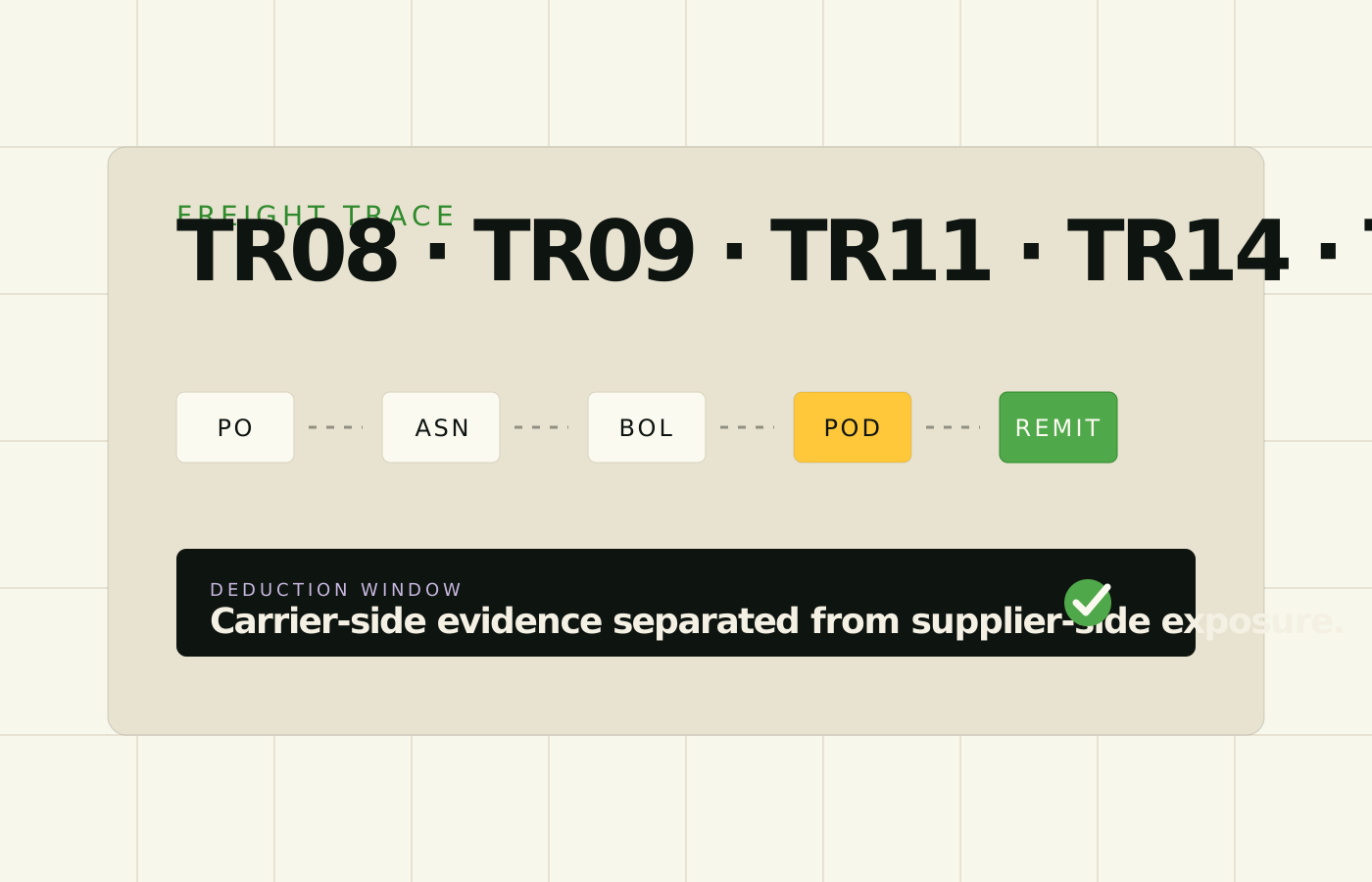
Target Freight Deductions Explained: TR08, TR09, TR11, TR14 & TR15
What triggers each code, what documentation you need, and how to dispute them.

Jan 17, 2026
RetailPath X Unlockt Brands
Turning unpaid invoices and deductions into recovered revenue

Jan 14, 2026
Target Unpaid Invoices Explained
Learn why Target leaves invoices unpaid and how RetailPath’s AI recovers your missing payments automatically.
Stop writing off deductions
Find out what retailers owe you.
Less time chasing deductions. More margin behind the products you love making.